Skip to content
Adaptive

Learn Chemistry — Math expr, Mole moles (extended)

Read the notes, then try the practice. It adapts as you go.When you're ready.

Session Length

~14 min

Adaptive Checks

13 questions

Transfer Probes

7

Lesson Notes

Chemistry is the branch of natural science that studies the composition, structure, properties, and transformations of matter. Often called the central science, chemistry bridges physics with biology and earth sciences, providing a molecular-level understanding of the world around us. From the air we breathe to the medicines we take, every material substance is governed by chemical principles. The discipline encompasses the study of atoms and molecules, how they interact through chemical bonds, and how energy is exchanged during chemical reactions. Understanding chemistry is essential for anyone seeking to comprehend the fundamental processes that sustain life and drive modern technology.

The major sub-disciplines of chemistry include organic chemistry, which focuses on carbon-containing compounds and forms the basis of biochemistry and pharmaceutical science; inorganic chemistry, which studies metals, minerals, and organometallic compounds; physical chemistry, which applies the principles of physics to chemical systems through thermodynamics, kinetics, and quantum mechanics; and analytical chemistry, which develops methods and instruments to determine what substances are present in a sample and in what quantities. Electrochemistry, nuclear chemistry, and environmental chemistry are additional branches that address specialized areas of inquiry, each contributing valuable knowledge to industry, medicine, and environmental stewardship.

Studying chemistry equips learners with critical thinking and quantitative reasoning skills that are transferable across many career paths. Whether you are interested in developing new materials, understanding how drugs interact with the body, improving energy storage technologies, or addressing environmental pollution, a solid grounding in chemistry is indispensable. This topic covers atomic structure, chemical bonding, stoichiometry, thermodynamics, acid-base chemistry, the basics of organic chemistry, and electrochemistry, providing a well-rounded foundation for further study in any scientific or engineering field.

You'll be able to:

  • Explain atomic structure, periodic trends, and chemical bonding theories that govern molecular properties
  • Apply stoichiometry, equilibrium, and thermodynamic principles to predict and quantify chemical reaction outcomes
  • Analyze reaction mechanisms to determine rate laws, intermediates, and energy profiles of chemical transformations
  • Evaluate experimental data from spectroscopic and analytical techniques to identify unknown chemical compounds

One step at a time.

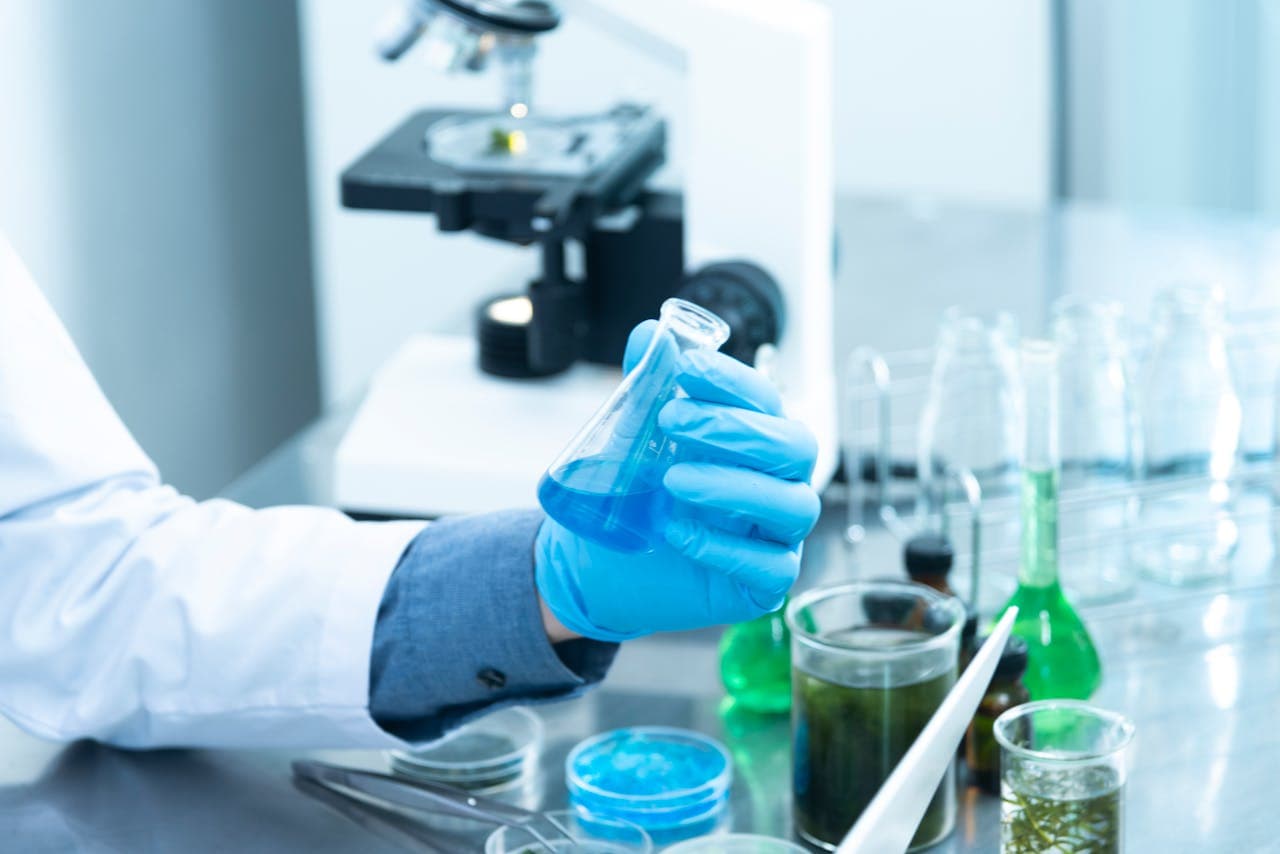
Chemistry laboratory with glassware and equipment
Where theory meets experimentPexels

Key Concepts

Atomic Structure

Atoms consist of a dense nucleus containing protons and neutrons, surrounded by electrons occupying quantized energy levels called orbitals. The number of protons defines the element, while the arrangement of electrons determines chemical reactivity and bonding behavior.

Periodic table of elements showing atomic structure groups

Example: A carbon atom has 6 protons and typically 6 neutrons in its nucleus, with 6 electrons arranged in two energy levels (2 in the first shell, 4 in the second), giving it four valence electrons available for bonding.

Chemical Bonding

Chemical bonds are the attractive forces that hold atoms together in compounds. The three primary types are ionic bonds (transfer of electrons between atoms), covalent bonds (sharing of electron pairs), and metallic bonds (delocalized electron sea among metal cations).

Lewis dot structure showing covalent bonding

Example: Sodium chloride ($\text{NaCl}$) is formed by an ionic bond where sodium donates one electron to chlorine, whereas water ($\text{H}_2\text{O}$) is held together by polar covalent bonds where oxygen shares electrons unequally with hydrogen.

Stoichiometry

Stoichiometry is the quantitative study of the relative amounts of reactants and products in chemical reactions. It relies on balanced chemical equations and the mole concept to predict how much product can be formed from given quantities of reactants.

Example: In the combustion of methane, $\text{CH}_4 + 2\text{O}_2 \rightarrow \text{CO}_2 + 2\text{H}_2\text{O}$, stoichiometry tells us that one mole of methane reacts with exactly two moles of oxygen to produce one mole of carbon dioxide and two moles of water.

The Mole Concept

The mole is the SI unit for the amount of substance, defined as exactly $6.022 \times 10^{23}$ representative particles (Avogadro's number). It provides the critical bridge between the atomic scale, where individual atoms and molecules exist, and the macroscopic scale of grams and liters used in the laboratory.

Example: One mole of carbon-12 atoms has a mass of exactly 12 grams and contains $6.022 \times 10^{23}$ atoms, allowing chemists to weigh out predictable numbers of atoms for reactions.

Chemical Thermodynamics

Chemical thermodynamics studies the energy changes that accompany chemical reactions and phase transitions. Key concepts include enthalpy (heat content), entropy (disorder), and Gibbs free energy, which determines whether a reaction will proceed spontaneously under given conditions.

Example: The combustion of gasoline is exothermic (negative enthalpy change) and increases entropy by producing many small gas molecules, making it highly spontaneous with a large negative Gibbs free energy.

Acid-Base Chemistry

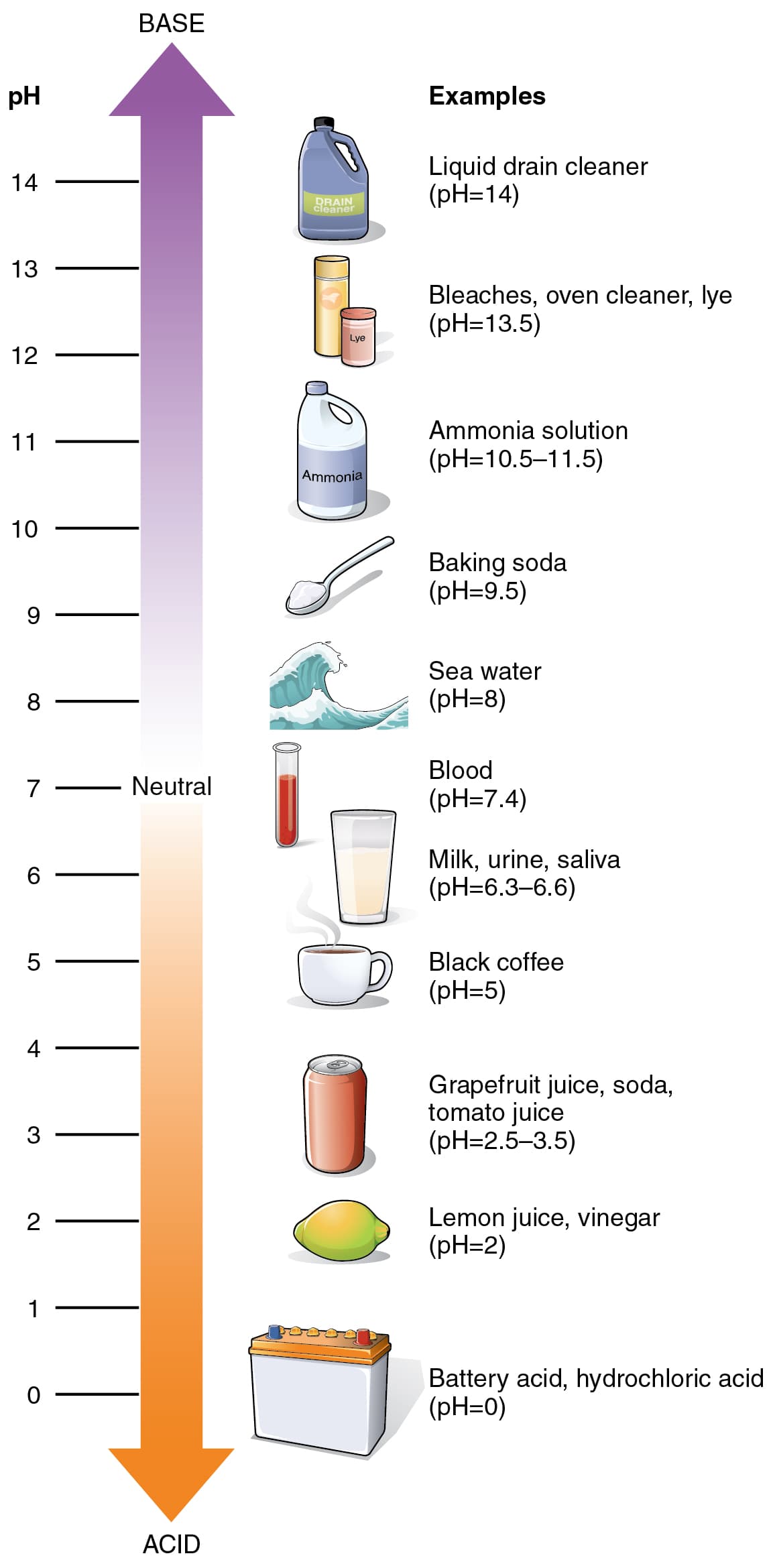
Acids are substances that donate protons ($\text{H}^+$ ions) or accept electron pairs, while bases accept protons or donate electron pairs. The pH scale, ranging from 0 to 14, quantifies the acidity or basicity of a solution based on the concentration of hydrogen ions.

The pH scale showing acid, neutral, and base ranges

Example: Hydrochloric acid ($\text{HCl}$) is a strong acid that fully dissociates in water to release $\text{H}^+$ ions, lowering the pH below 7, while sodium hydroxide ($\text{NaOH}$) is a strong base that releases $\text{OH}^-$ ions, raising the pH above 7.

Chemical Equilibrium

Chemical equilibrium is the state in which the forward and reverse reactions occur at equal rates, resulting in constant concentrations of reactants and products. Le Chatelier's principle predicts how a system at equilibrium responds to changes in concentration, pressure, or temperature.

Example: In the Haber process for ammonia synthesis ($\text{N}_2 + 3\text{H}_2 \rightleftharpoons 2\text{NH}_3$), increasing pressure shifts the equilibrium toward the product side because the product has fewer gas molecules than the reactants.

Organic Chemistry Fundamentals

Organic chemistry is the study of carbon-containing compounds and their reactions. Carbon's ability to form four stable covalent bonds and create long chains, branched structures, and rings gives rise to an enormous diversity of molecules, including hydrocarbons, alcohols, carboxylic acids, and amines.

Example: Ethanol ($\text{C}_2\text{H}_5\text{OH}$) is an organic compound containing a hydroxyl functional group, which makes it miscible with water and gives it its characteristic properties as both a beverage component and a solvent.

More terms are available in the glossary.

Explore your way

Choose a different way to engage with this topic — no grading, just richer thinking.

Explore your way — choose one:

Explore with AI →

Concept Map

See how the key ideas connect. Nodes color in as you practice.

Worked Example

Walk through a solved problem step-by-step. Try predicting each step before revealing it.

Adaptive Practice

This is guided practice, not just a quiz. Hints and pacing adjust in real time.

Small steps add up.

What you get while practicing:

  • Math Lens cues for what to look for and what to ignore.
  • Progressive hints (direction, rule, then apply).
  • Targeted feedback when a common misconception appears.

Teach It Back

The best way to know if you understand something: explain it in your own words.

Keep Practicing

More ways to strengthen what you just learned.

Chemistry — Math expr, Mole moles (extended) Adaptive Course - Learn with AI Support | PiqCue