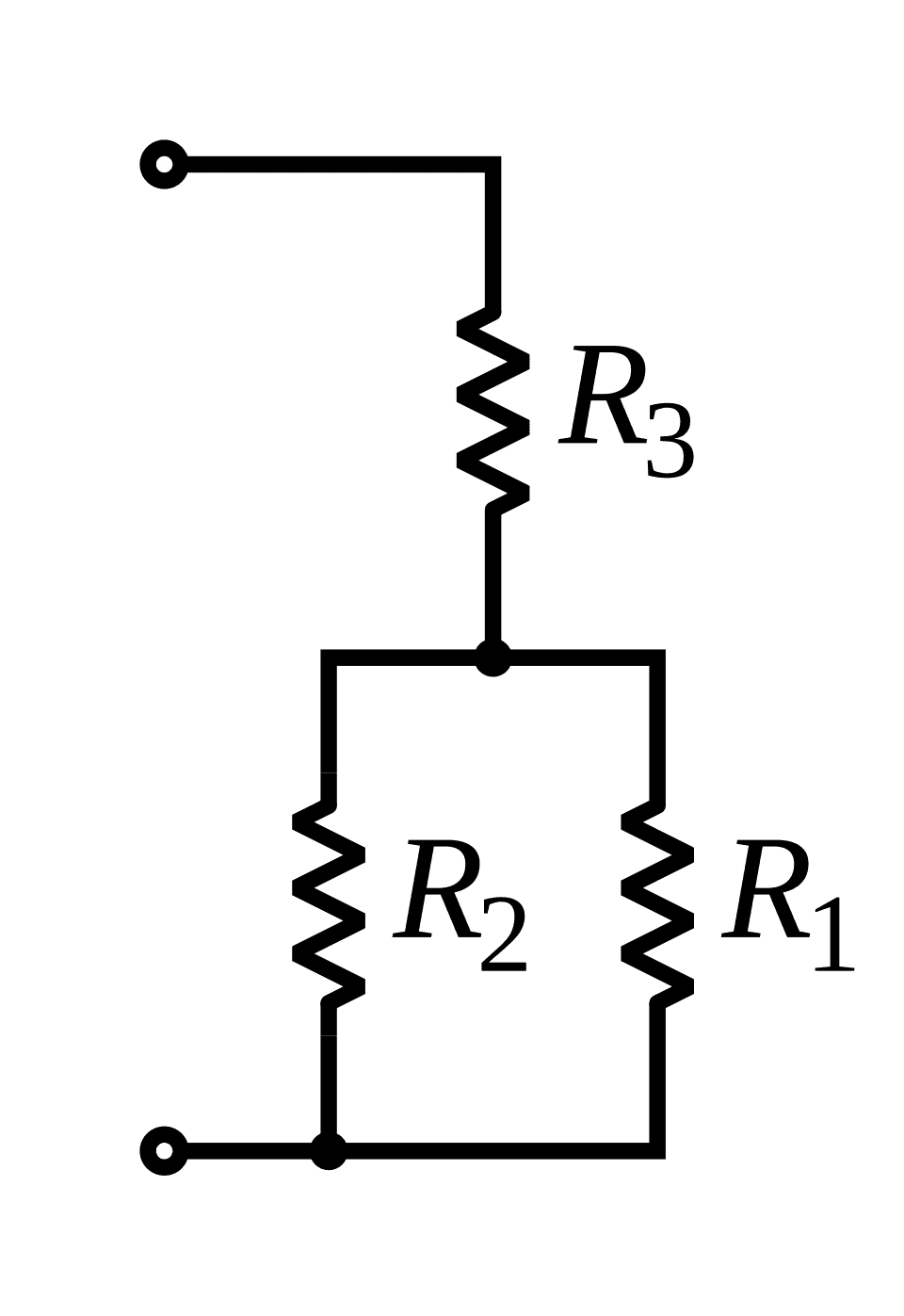
Electric circuits are the backbone of modern technology, governing the flow of electric charge through interconnected components to perform useful work. At the AP Physics 2 level, circuit analysis centers on the relationships between current, voltage, and resistance as described by Ohm's law ($V = IR$), the rules governing series and parallel combinations of resistors and capacitors, and the energy and power considerations that determine how circuits convert electrical energy into heat, light, motion, and other forms. Understanding circuits requires connecting the macroscopic quantities measured by instruments (ammeter readings, voltmeter readings) to the microscopic picture of charge carriers drifting through conductors under the influence of electric fields.
Kirchhoff's laws provide the systematic framework for analyzing complex circuits. Kirchhoff's junction rule (conservation of charge) states that the total current entering any junction equals the total current leaving it. Kirchhoff's loop rule (conservation of energy) states that the sum of all voltage gains and drops around any closed loop in a circuit is zero. Together, these laws allow students to set up and solve systems of equations for circuits that cannot be reduced to simple series-parallel combinations. These principles extend naturally to circuits containing capacitors, where charge storage and the time-dependent behavior of RC circuits introduce the concept of exponential charging and discharging.
Capacitors store energy in the electric field between their plates, with capacitance $C = Q/V$ quantifying the charge-to-voltage ratio. In RC circuits, the time constant $\tau = RC$ governs how quickly capacitors charge and discharge, producing exponential current and voltage curves that are fundamental to timing circuits, filters, and signal processing. Power dissipation in resistive circuits follows $P = IV = I^2R = V^2/R$, connecting circuit analysis to energy transfer and thermal effects. Mastery of circuit concepts is essential for understanding the electrical systems that underpin everything from household wiring to the microprocessors in computers.