Skip to content
Adaptive

Learn Physics

Read the notes, then try the practice. It adapts as you go.When you're ready.

Session Length

~13 min

Adaptive Checks

12 questions

Transfer Probes

6

Lesson Notes

Physics is the foundational natural science that investigates matter, energy, and the fundamental forces governing the universe. From the subatomic realm of quarks and leptons to the large-scale structure of galaxies and cosmic filaments, physics seeks to uncover the quantitative laws that describe how the physical world behaves. Its core branches include classical mechanics, which describes the motion of macroscopic objects under the influence of forces; thermodynamics and statistical mechanics, which connect the microscopic behavior of particles to macroscopic properties like temperature and pressure; electromagnetism, which unifies electric and magnetic phenomena into a single elegant framework; and optics, which explores the behavior of light as both a wave and a particle.

Modern physics, born in the early twentieth century, dramatically expanded our understanding of nature at extreme scales. Albert Einstein's special and general theories of relativity revealed that space and time are interwoven into a four-dimensional fabric that is curved by mass and energy, fundamentally altering our conceptions of gravity, simultaneity, and the speed of light as an absolute cosmic speed limit. Quantum mechanics, developed by pioneers such as Max Planck, Niels Bohr, Werner Heisenberg, and Erwin Schrodinger, demonstrated that at the atomic and subatomic level, particles exhibit wave-particle duality, energy is quantized, and measurement outcomes are inherently probabilistic. Together, relativity and quantum mechanics form the two pillars of modern physics and underpin technologies ranging from GPS satellites to semiconductor chips.

Physics is also a deeply practical discipline whose discoveries drive technological innovation across every sector of modern life. The principles of electromagnetism gave rise to electric power generation, radio communication, and fiber-optic networks. Quantum mechanics enabled the invention of lasers, transistors, and magnetic resonance imaging. Nuclear physics led to both nuclear energy and medical isotope therapies. Today, physicists push the frontiers of knowledge through experiments at particle accelerators like the Large Hadron Collider, observations from space telescopes like the James Webb Space Telescope, and theoretical work on unifying gravity with quantum mechanics through candidates such as string theory and loop quantum gravity. Studying physics cultivates rigorous analytical thinking, mathematical fluency, and a capacity for modeling complex systems -- skills that are valued in careers spanning engineering, data science, finance, and academia.

You'll be able to:

  • Apply Newtonian mechanics principles including force analysis and energy conservation to solve multi-body system problems
  • Analyze electromagnetic theory using Maxwell's equations to explain wave propagation, field interactions, and circuit behavior
  • Evaluate thermodynamic laws and statistical mechanics frameworks to predict energy transfer and entropy in physical systems
  • Distinguish between classical and quantum mechanical descriptions of matter and radiation at atomic and subatomic scales

One step at a time.

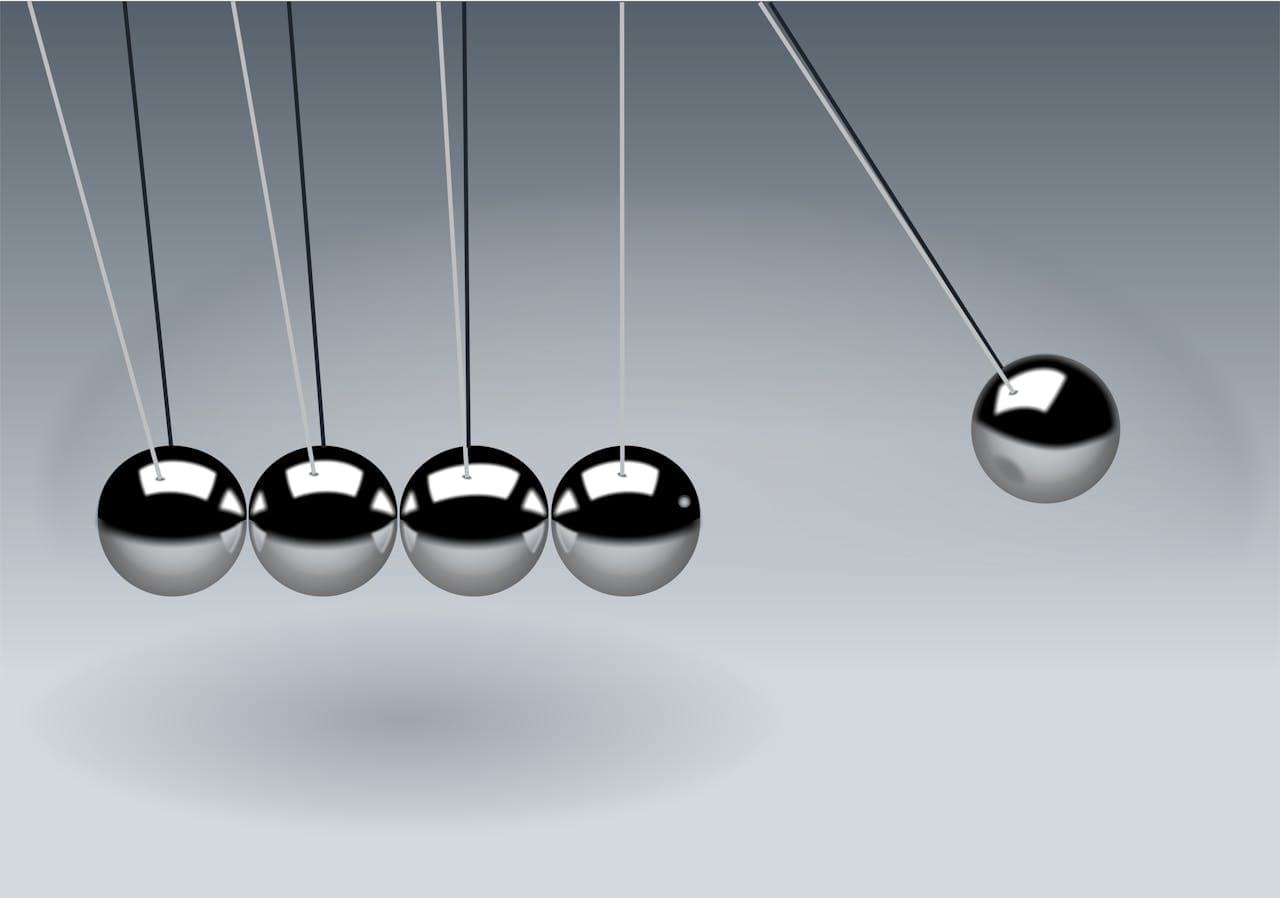
Physics laboratory equipment
Exploring the laws of naturePexels

Interactive Exploration

Adjust the controls and watch the concepts respond in real time.

Key Concepts

Newton's Laws of Motion

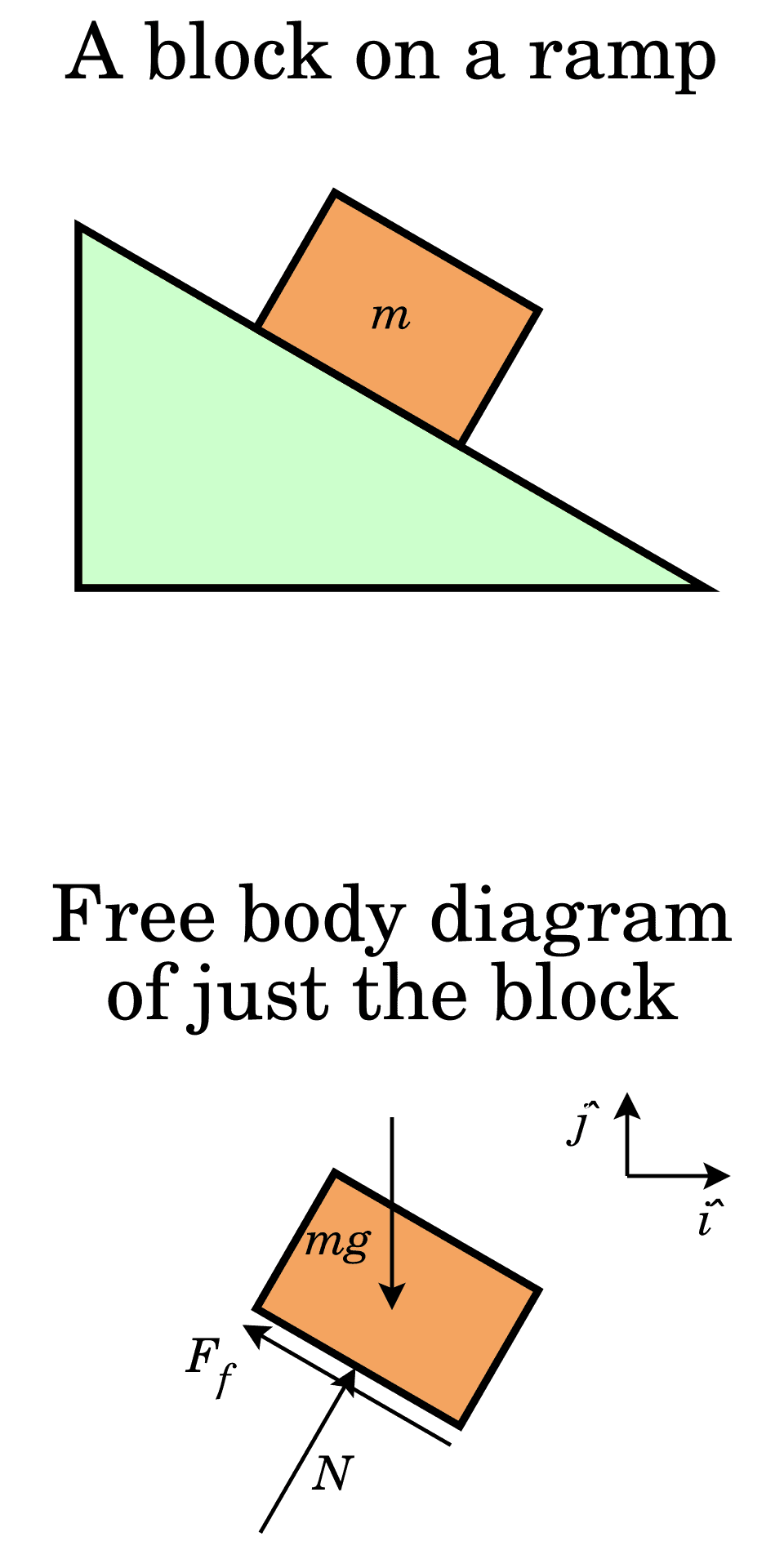
Three foundational laws formulated by Isaac Newton that describe the relationship between a body and the forces acting upon it. The first law (inertia) states an object remains at rest or in uniform motion unless acted upon by a net force; the second law relates force to mass times acceleration ($F = ma$); and the third law states every action has an equal and opposite reaction.

Free-body diagram showing forces acting on an object

Example: When you push a shopping cart (action force), the cart pushes back on your hands with an equal force in the opposite direction (reaction force), illustrating Newton's third law.

Conservation of Energy

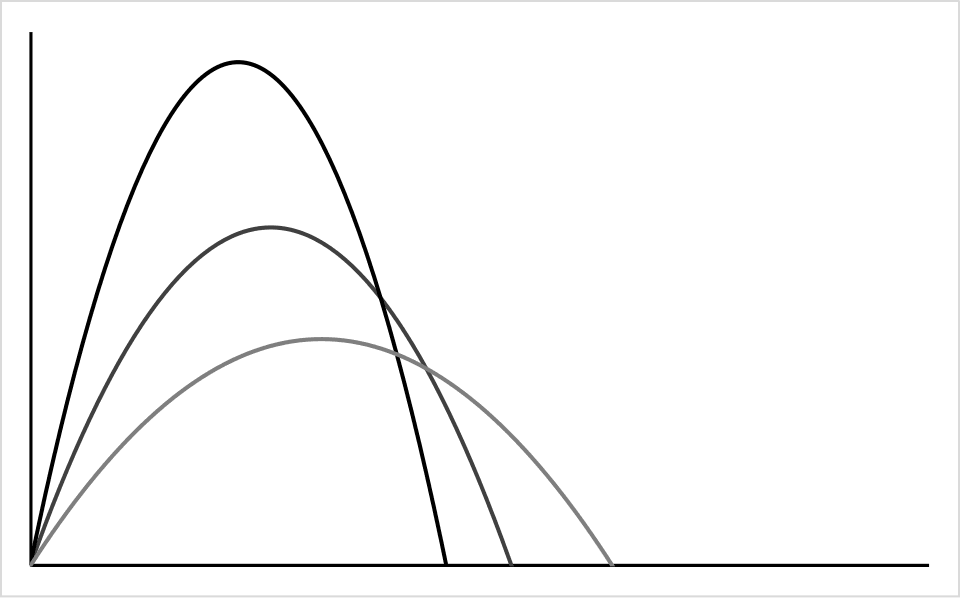
A fundamental principle stating that the total energy of an isolated system remains constant over time. Energy can be transformed from one form to another -- such as kinetic to potential or thermal -- but it cannot be created or destroyed. This law applies universally across all branches of physics.

Projectile motion diagram illustrating energy conservation

Example: A roller coaster at the top of a hill has maximum gravitational potential energy, which converts to kinetic energy as it descends, with the total mechanical energy remaining constant in the absence of friction.

Electromagnetic Waves

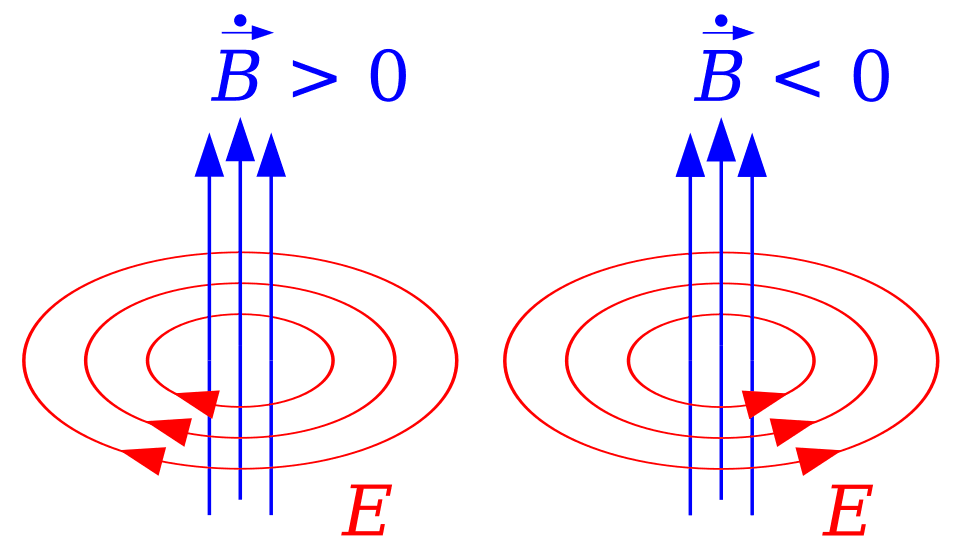
Self-propagating oscillations of electric and magnetic fields that travel through a vacuum at the speed of light, approximately $3 \times 10^8$ meters per second. They span a broad spectrum from low-frequency radio waves to high-frequency gamma rays, and they require no medium for propagation, unlike mechanical waves.

Electromagnetic wave propagation diagram

Example: Visible light, which allows human vision, occupies a narrow band of the electromagnetic spectrum with wavelengths between roughly 400 nanometers (violet) and 700 nanometers (red).

Thermodynamic Laws

A set of four fundamental laws governing heat, work, temperature, and entropy. The zeroth law establishes thermal equilibrium; the first law is conservation of energy applied to thermal systems; the second law states that entropy in an isolated system never decreases; and the third law states that absolute zero temperature cannot be reached in a finite number of steps.

Example: A refrigerator operates by doing work to transfer heat from a cold interior to the warmer room outside, consistent with the second law, which requires energy input to move heat against its natural gradient.

Wave-Particle Duality

The quantum mechanical principle that every particle or quantum entity exhibits both wave-like and particle-like properties depending on the experimental context. Photons, for instance, produce interference patterns like waves but also deliver energy in discrete packets when detected. This duality is central to quantum theory and challenges classical intuition.

Example: In the double-slit experiment, individual electrons are detected as discrete points on a screen, yet over many detections they form an interference pattern characteristic of waves.

Special Relativity

Einstein's 1905 theory postulating that the laws of physics are the same in all inertial reference frames and that the speed of light in a vacuum is constant for all observers regardless of their motion. It leads to time dilation, length contraction, and the famous mass-energy equivalence $E = mc^2$.

Example: Muons created by cosmic rays in the upper atmosphere travel much farther than their short half-life would classically permit because time dilation slows their internal clocks relative to an observer on the ground.

Electric Fields and Coulomb's Law

An electric field is a region of space around a charged particle where other charges experience a force. Coulomb's law quantifies the electrostatic force between two point charges as proportional to the product of their charges and inversely proportional to the square of the distance between them. This inverse-square relationship mirrors the form of Newton's law of gravitation.

Example: Two positive charges separated by 1 meter repel each other, and if the distance is halved to 0.5 meters, the repulsive force increases by a factor of four.

Heisenberg Uncertainty Principle

A fundamental limit in quantum mechanics stating that certain pairs of physical properties, such as position and momentum, cannot both be simultaneously measured with arbitrary precision. The more precisely one property is known, the less precisely the other can be determined. This is not a limitation of instruments but a fundamental feature of nature.

Example: If an electron's position is measured very precisely using a high-energy photon, the photon's impact significantly alters the electron's momentum, making the momentum highly uncertain.

More terms are available in the glossary.

Explore your way

Choose a different way to engage with this topic — no grading, just richer thinking.

Explore your way — choose one:

More ways to explore
Explore with AI →

Concept Map

See how the key ideas connect. Nodes color in as you practice.

Worked Example

Walk through a solved problem step-by-step. Try predicting each step before revealing it.

Adaptive Practice

This is guided practice, not just a quiz. Hints and pacing adjust in real time.

Small steps add up.

What you get while practicing:

  • Math Lens cues for what to look for and what to ignore.
  • Progressive hints (direction, rule, then apply).
  • Targeted feedback when a common misconception appears.

Teach It Back

The best way to know if you understand something: explain it in your own words.

Keep Practicing

More ways to strengthen what you just learned.

Physics Adaptive Course - Learn with AI Support | PiqCue