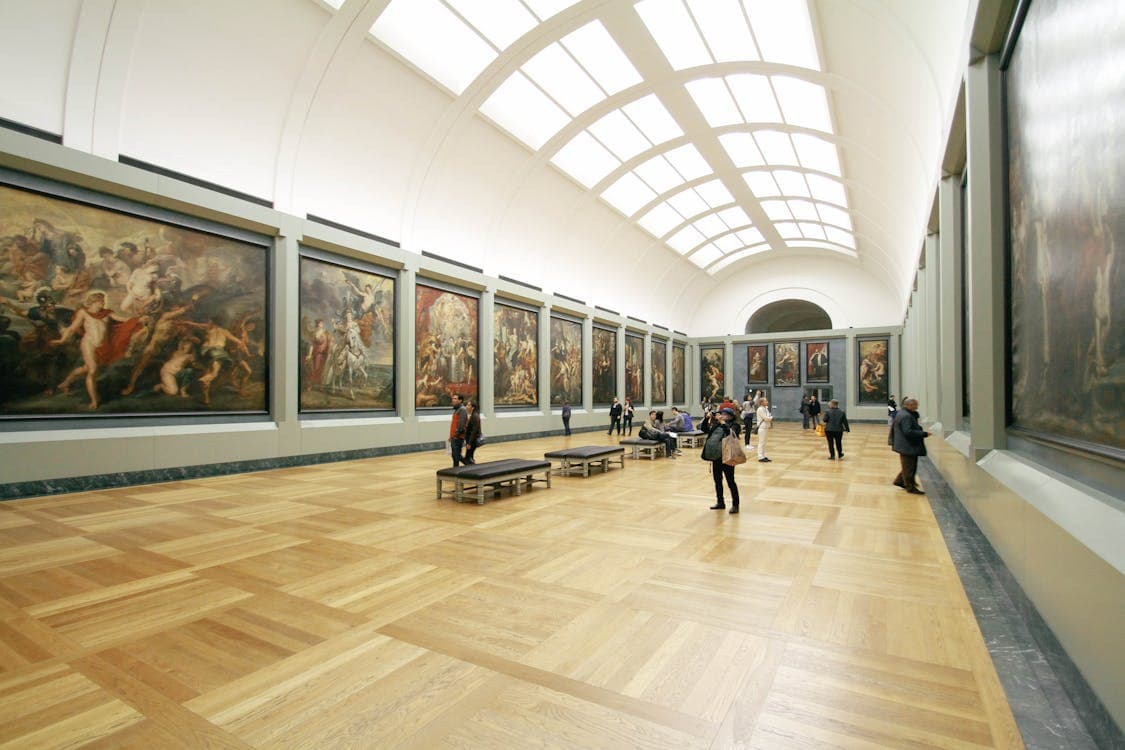
Renaissance Art
IntermediateRenaissance art refers to the painting, sculpture, architecture, and decorative arts produced in Europe during the period roughly spanning the 14th through the 17th centuries. Originating in Italy during the late Middle Ages, the Renaissance marked a profound cultural shift characterized by a renewed interest in the classical art and philosophy of ancient Greece and Rome. Artists moved away from the flat, symbolic imagery of medieval art toward naturalistic depictions of the human body, convincing spatial depth achieved through linear perspective, and emotionally expressive compositions grounded in direct observation of the natural world.
The Italian Renaissance is traditionally divided into three phases: the Early Renaissance (circa 1400-1490), centered in Florence and driven by pioneers such as Masaccio, Brunelleschi, and Donatello; the High Renaissance (circa 1490-1527), dominated by Leonardo da Vinci, Michelangelo, and Raphael working primarily in Florence and Rome; and the Late Renaissance or Mannerist period (circa 1520-1600), which deliberately subverted High Renaissance ideals of harmony and proportion. The movement was sustained by a powerful system of patronage, with wealthy families like the Medici, the Catholic Church, and secular rulers commissioning works that simultaneously celebrated religious devotion, civic pride, and humanist learning.
Beyond Italy, Renaissance ideals spread throughout Europe in what is known as the Northern Renaissance. Artists such as Jan van Eyck, Albrecht Dürer, and Pieter Bruegel the Elder adapted Italian innovations to distinct regional traditions, placing particular emphasis on meticulous surface detail, oil painting technique, and scenes of everyday life. The legacy of Renaissance art is immense: it established the principles of pictorial composition, anatomical accuracy, and perspective that dominated Western art for centuries, and it elevated the social status of the artist from anonymous craftsman to celebrated creative genius.
Practice a little. See where you stand.
Quiz
Reveal what you know — and what needs work
Adaptive Learn
Responds to how you reason, with real-time hints
Flashcards
Build recall through spaced, active review
Cheat Sheet
The essentials at a glance — exam-ready
Glossary
Master the vocabulary that unlocks understanding
Learning Roadmap
A structured path from foundations to mastery
Book
Deep-dive guide with worked examples
Lab
Hands-on practice for this subject
Key Concepts
One concept at a time.
Explore your way
Choose a different way to engage with this topic — no grading, just richer thinking.
Explore your way — choose one:
Curriculum alignment— Standards-aligned
Grade level
Learning objectives
- •Analyze the use of linear perspective, chiaroscuro, and anatomical realism in works by Leonardo, Michelangelo, and Raphael
- •Evaluate how patronage systems of the Medici, papacy, and merchant classes shaped artistic production and iconographic programs
- •Compare Northern Renaissance and Italian Renaissance artistic conventions regarding technique, symbolism, cultural context, and patronage influences
- •Identify the influence of classical antiquity, humanism, and scientific inquiry on the transformation of visual representation
Recommended Resources
This page contains affiliate links. We may earn a commission at no extra cost to you.
Books
The Lives of the Most Excellent Painters, Sculptors, and Architects
by Giorgio Vasari
The Story of Art
by E.H. Gombrich
Italian Renaissance Painting
by Sara Elliott
Renaissance Art: A Very Short Introduction
by Geraldine A. Johnson
The Art of the Italian Renaissance: Architecture, Sculpture, Painting, Drawing
by Rolf Toman (editor)
Related Topics
Art History
The study of visual arts across cultures and centuries, examining how painting, sculpture, and architecture reflect evolving aesthetic ideals, social conditions, and philosophical ideas from antiquity to the present day.
Architecture
The art and science of designing buildings and physical structures, integrating aesthetics, engineering, cultural expression, and environmental responsibility to shape the human-built environment.
Baroque Art
A dramatic, ornamental artistic style of the 17th and early 18th centuries characterized by bold contrasts, vivid color, emotional intensity, and grandeur.