Skip to content
Adaptive

Learn Renaissance Art

Read the notes, then try the practice. It adapts as you go.When you're ready.

Session Length

~17 min

Adaptive Checks

15 questions

Transfer Probes

8

Lesson Notes

Renaissance art refers to the painting, sculpture, architecture, and decorative arts produced in Europe during the period roughly spanning the 14th through the 17th centuries. Originating in Italy during the late Middle Ages, the Renaissance marked a profound cultural shift characterized by a renewed interest in the classical art and philosophy of ancient Greece and Rome. Artists moved away from the flat, symbolic imagery of medieval art toward naturalistic depictions of the human body, convincing spatial depth achieved through linear perspective, and emotionally expressive compositions grounded in direct observation of the natural world.

The Italian Renaissance is traditionally divided into three phases: the Early Renaissance (circa 1400-1490), centered in Florence and driven by pioneers such as Masaccio, Brunelleschi, and Donatello; the High Renaissance (circa 1490-1527), dominated by Leonardo da Vinci, Michelangelo, and Raphael working primarily in Florence and Rome; and the Late Renaissance or Mannerist period (circa 1520-1600), which deliberately subverted High Renaissance ideals of harmony and proportion. The movement was sustained by a powerful system of patronage, with wealthy families like the Medici, the Catholic Church, and secular rulers commissioning works that simultaneously celebrated religious devotion, civic pride, and humanist learning.

Beyond Italy, Renaissance ideals spread throughout Europe in what is known as the Northern Renaissance. Artists such as Jan van Eyck, Albrecht Dürer, and Pieter Bruegel the Elder adapted Italian innovations to distinct regional traditions, placing particular emphasis on meticulous surface detail, oil painting technique, and scenes of everyday life. The legacy of Renaissance art is immense: it established the principles of pictorial composition, anatomical accuracy, and perspective that dominated Western art for centuries, and it elevated the social status of the artist from anonymous craftsman to celebrated creative genius.
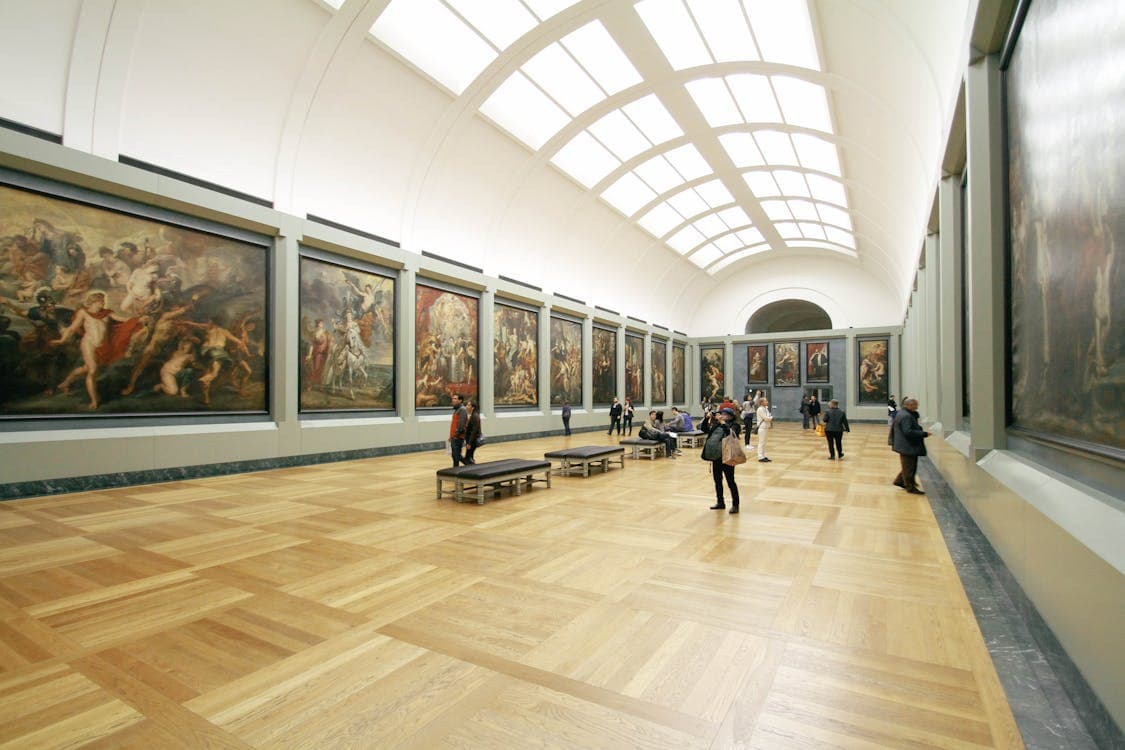
You'll be able to:

  • Analyze the use of linear perspective, chiaroscuro, and anatomical realism in works by Leonardo, Michelangelo, and Raphael
  • Evaluate how patronage systems of the Medici, papacy, and merchant classes shaped artistic production and iconographic programs
  • Compare Northern Renaissance and Italian Renaissance artistic conventions regarding technique, symbolism, cultural context, and patronage influences
  • Identify the influence of classical antiquity, humanism, and scientific inquiry on the transformation of visual representation

One step at a time.

Interactive Exploration

Adjust the controls and watch the concepts respond in real time.

Key Concepts

Linear Perspective

A mathematical system for creating the illusion of three-dimensional depth on a flat surface by making parallel lines converge toward a single vanishing point on the horizon line. Formalized by Filippo Brunelleschi around 1415 and codified by Leon Battista Alberti in his treatise 'De Pictura' (1435).

Example: Masaccio's 'The Holy Trinity' (c. 1427) in Santa Maria Novella, Florence, uses a single vanishing point to create a convincing barrel-vaulted chapel that appears to recede into the wall.

Chiaroscuro

The use of strong contrasts between light and dark to model three-dimensional forms and create a dramatic sense of volume and atmosphere in a painting or drawing.

Example: Leonardo da Vinci's 'Virgin of the Rocks' employs subtle gradations from deep shadow to bright highlights to give the figures a lifelike, sculptural quality.

Sfumato

A painting technique in which colors and tones are blended so subtly that there are no perceptible transitions or harsh outlines, producing a soft, smoky effect. The term derives from the Italian word for 'smoke.'

Example: The enigmatic smile and softly modeled features of Leonardo da Vinci's 'Mona Lisa' are achieved through multiple thin layers of translucent glaze that blur the edges of the lips and eyes.

Humanism

An intellectual movement central to the Renaissance that emphasized the study of classical Greek and Roman texts, the dignity and potential of the individual, and the value of secular knowledge alongside religious faith.

Example: Raphael's 'The School of Athens' depicts ancient philosophers such as Plato and Aristotle at the center of a grand architectural space, celebrating human reason and classical learning.

Contrapposto

A sculptural and pictorial pose in which the human figure stands with most of its weight on one leg, causing the shoulders and hips to tilt in opposite directions. Revived from ancient Greek sculpture during the Renaissance.

Example: Michelangelo's 'David' (1501-1504) stands in a relaxed contrapposto stance, with his weight on his right leg, creating a naturalistic S-curve through the body.

Patronage

The financial and social support provided by wealthy individuals, families, the Church, or civic institutions to artists and architects, which was the primary economic engine for Renaissance art production.

Example: The Medici family of Florence commissioned works from Botticelli, Michelangelo, and many others, shaping the artistic character of the city for over a century.

Fresco

A mural painting technique in which pigment is applied to freshly laid wet plaster ('buon fresco'), causing the colors to become part of the wall surface as the plaster dries, resulting in exceptional durability.

Example: Michelangelo's ceiling of the Sistine Chapel (1508-1512) was executed in buon fresco, requiring the artist to paint each section quickly before the plaster dried.

Oil Painting

A technique using pigments bound in drying oil (typically linseed oil) that allows for rich color, subtle blending, fine detail, and slow drying time. Perfected by Netherlandish painters in the 15th century and adopted throughout Europe.

Example: Jan van Eyck's 'Arnolfini Portrait' (1434) showcases the luminous color, meticulous detail, and layered glazes made possible by the oil medium.

More terms are available in the glossary.

Explore your way

Choose a different way to engage with this topic — no grading, just richer thinking.

Explore your way — choose one:

Explore with AI →

Concept Map

See how the key ideas connect. Nodes color in as you practice.

Worked Example

Walk through a solved problem step-by-step. Try predicting each step before revealing it.

Adaptive Practice

This is guided practice, not just a quiz. Hints and pacing adjust in real time.

Small steps add up.

What you get while practicing:

  • Math Lens cues for what to look for and what to ignore.
  • Progressive hints (direction, rule, then apply).
  • Targeted feedback when a common misconception appears.

Teach It Back

The best way to know if you understand something: explain it in your own words.

Keep Practicing

More ways to strengthen what you just learned.

Renaissance Art Adaptive Course - Learn with AI Support | PiqCue